VIP Thermal Physics vs Foam: Cooler Performance & Trade-Offs
By Ayo Okonkwo • 6th May
When your crew's cold beverages and lunch fail mid-shift, productivity doesn't just dip, it collapses. On a scorching August paving job, a cooler that couldn't hold temperature left people reaching for warm water by noon. The morale hit was immediate; so was the time lost. That job taught me that vacuum insulation cooler science isn't academic. It is operational control. Understanding how VIP thermal physics compares to traditional foam insulation directly translates to uptime, safety, and crew ROI.
Cooler insulation falls into two dominant camps: vacuum insulation panels (VIPs) and foam. Both work, but the physics, costs, and real-world failures tell very different stories. This article unpacks the trade-offs so you can spec the right technology for your climate, duty cycle, and risk tolerance.
What Is VIP Technology?
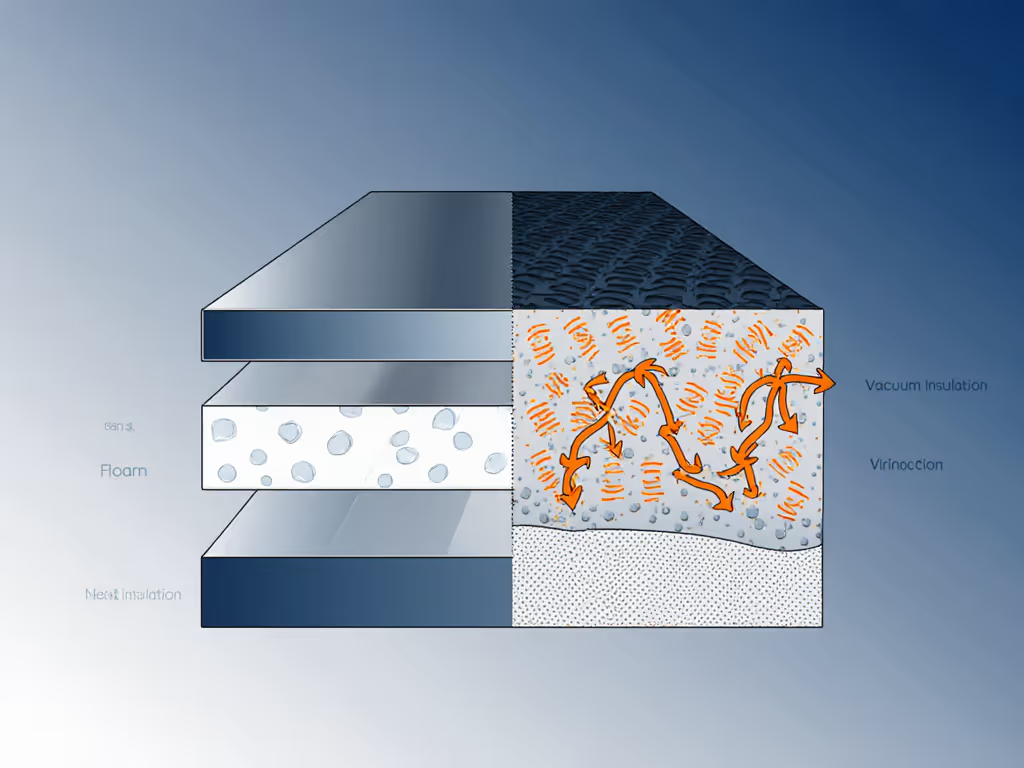
Vacuum insulation panel technology uses a microporous core (typically silica-based) sealed inside an envelope with all air removed. For a deeper materials breakdown of VIPs versus foams, see our cooler insulation materials guide. The vacuum blocks three mechanisms of heat transfer: conduction (through air), convection (air movement), and it reflects most radiation via low-emissivity coatings on the interior surfaces.
The result: extremely high R-value per inch. A 1-inch VIP panel can deliver R-30 to R-45, depending on the core material and fill density. For comparison, foam typically offers R-3.5 to R-7 per inch. On paper, that means thinner walls, lighter coolers, and faster cooling (all attractive to engineers and weight-conscious buyers).
However, VIP panels have a critical vulnerability: the seal. Once the envelope is breached (by impact, sharp edges, or rough handling) the vacuum collapses and insulation performance drops dramatically. A compromised VIP panel typically falls to R-8 or lower, losing its thermal advantage within hours. Cold that survives chaos is the only cold that counts. That principle favors redundancy over theoretical peak performance.
How Foam Insulation Performs
Foam, whether expanded polystyrene (EPS), polyurethane, or polyiso, relies on trapped air pockets within the material matrix. Conduction still occurs through the foam skeleton; convection is eliminated by the tiny cells. R-value is lower per inch than VIP, but the degradation is gradual and forgiving.
A dented foam wall still insulates. Moisture ingress degrades it slowly over weeks or months, not minutes. That redundancy matters in the field. If a cooler takes a hit on a truck bed or gets dropped, foam coolers still perform predictably the next day. VIP coolers do not, unless the seal held.
Comparative Analysis: Performance, Cost, and Durability
Thermal Performance
In controlled lab conditions with no disturbance, a VIP cooler will outperform an equivalent foam cooler by 15-25% in hold time, depending on ambient temperature and opening frequency. For methodology and real test data, see our 24-hour ice retention comparison. On a 90°F day with minimal lid opening, a VIP cooler might hold ice 2-4 hours longer than foam of the same wall thickness.
In real-world scenarios (trucks bouncing over job sites, boats slamming through waves, tailgates with frequent access) the advantage shrinks. Why? Because:
- Pre-chill is the dominant variable. A thoroughly pre-chilled foam cooler often outlasts a hastily loaded VIP cooler. The difference: 2-3 crew hours of cold capacity, which translates directly to hydration availability and lunch safety.
- Frequency of lid opening matters more than insulation type. Every opening dumps 5-15°F of internal air. Even a VIP cooler with an R-40 wall can't recover from 20 openings per hour on a hot site.
- Solar gain and ambient heat dominate in open-air worksites. A cooler sitting in direct sun on a steel deck absorbs heat from below and above. Insulation R-value alone doesn't counter 140°F+ surface temperatures without shade, light-colored exterior, and strategic placement.
Temperature Stability
Temperature stability with vacuum insulation is theoretically superior, but field data shows the gain diminishes when crews rely on proper staging instead of cooler alone. A risk register for cooler failure typically lists these mitigation steps:
- Pre-chill all units overnight (reduces internal temp by 10-20°F)
- Shade coolers continuously (prevents solar gain, the #1 heat source on open sites)
- Separate food and hydration into dedicated coolers (reduces total openings and air intrusion)
- Assign a cooler chief to enforce a packing and opening protocol
When these SOPs are in place, foam coolers maintain 35-42°F for 8-12 hours. VIP coolers extend that by 1-3 hours under identical conditions. The cost and fragility trade-off often isn't justified for crews that work with discipline.
Lifecycle and Total Cost of Ownership
A VIP cooler starts 30-50% higher in purchase price. A mid-size foam rotomolded cooler runs $150-300; an equivalent VIP cooler costs $250-450. Over a 5-year duty cycle:
- Foam cooler: $200/unit x 5 years = $200/year in depreciation. Likely replaced once or twice due to UV damage, handle failure, or seal wear (not catastrophic, incremental).
- VIP cooler: $350/unit / 5 years = $70/year in depreciation, but one major impact (transit crash, dropped on concrete) renders it unreliable immediately. Replacement isn't gradual; it is sudden and unplanned.
For fleets, this creates a scheduling and budget headache. Before committing, compare cooler warranties and service quality across brands. VIP's theoretical efficiency doesn't justify the operational risk unless the cooler is carefully managed (labeled, assigned, audited) and inspected for seal integrity after every significant event.
Weight and Portability
VIP panels allow thinner, lighter cooler designs. A 50-quart VIP cooler might weigh 25-30 lbs empty; an equivalent foam cooler runs 35-45 lbs. Once loaded with ice and food, the difference shrinks to 10-15%. For a solo angler carrying a cooler from truck to boat, that 10 lbs matters. For a crew cooler stationed at a jobsite, it doesn't.
Yet there's a hidden cost: lighter VIPs are often more fragile. They use thinner exterior shells and less robust corner protection. A 45 lb foam cooler can be tossed between truck beds; a 30 lb VIP cooler should not be.
Trade-Offs and Risk Mitigation
When VIP Makes Sense
- Solo or small-group fishing/boating trips with careful gear handling and predictable conditions.
- Multi-day expeditions where weight reduction justifies the cost and risk (alpine camps, backpacking with coolers).
- Controlled environments: Air-conditioned offices, labs, or event setups where coolers aren't jostled.
- High-end catch preservation (high-value fish, game, or specialty food) where even 2-3 extra hours of hold time prevents spoilage.
When Foam Remains Superior
- Crew and fleet use: Durability, redundancy, and predictability under rough handling trump peak performance.
- Hot-climate jobs: Shade, pre-chill, and shade protocol mitigate heat stress; insulation type becomes secondary.
- Frequent replacement cycles: Foam's lower cost-per-unit absorbs damage and wear better than VIP's fragility risk.
- Secondary coolers: Budget-friendly backups reduce catastrophic failure risk if a primary cooler is damaged.
Cold chain is part of the safety. For crews working in heat, that cold chain must be resilient, not fragile.
Summary and Final Verdict
VIP thermal physics delivers measurably superior R-value per inch, enabling thinner walls and lighter coolers. In controlled conditions, VIP coolers hold temperature 15-25% longer than equivalent foam designs. However, that advantage erodes rapidly when operational stress enters the picture.
Foam insulation is forgiving. It degrades gradually, performs predictably even when dented or roughly handled, and costs less upfront and over time. For crews, worksites, and fleet operations, foam's redundancy and durability (not VIP's theoretical peak) translate to actual uptime and ROI.
Choose VIP if: You're willing to invest in careful gear management, your use case prioritizes weight and peak performance, and damage risk is controlled.
Choose foam if: You operate in high-heat climates, run crews or fleets, value durability and cost predictability, and stage your coolers with shade, pre-chill, and assignment discipline.
The best cooler isn't the one with the highest R-value; it is the one that survives your job, your climate, and your team's real-world handling. Spec for the worst day, not the best. That's how cold translates to confidence.
Related Articles